The hot and humid climate environment in summer is a major challenge for the storage and processing of health tea bags. Health tea is often made from a combination of natural medicinal and edible ingredients such as herbs, flowers, leaves, roots, and fruits. The texture of the ingredients is fluffy and porous, making them highly susceptible to absorbing water vapor, mold spores, and insect eggs from the air. Under high temperature and humidity conditions, microorganisms rapidly multiply and their eggs are easily hatched, causing tea bags to become damp, moldy, and infested with insects. This not only results in the loss of aroma and health active ingredients, but also leads to excessive bacterial growth, seriously affecting product quality and food safety, and shortening shelf life.
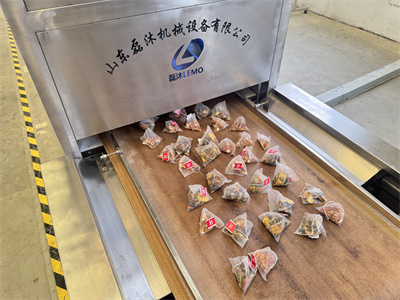
Traditional tea bag processing mainly relies on drying and dehydration as the main process, and sterilization and insecticidal eggs only rely on high-temperature waste heat for auxiliary treatment, which has obvious drawbacks. Traditional heat processing heats the tea bag from the surface to the inside, which can only act on the surface of the tea bag and is difficult to penetrate deep into the raw material fibers. Bacteria, molds, and dormant insect eggs hidden inside the material cannot be effectively removed, and later storage is prone to secondary growth.
In response to the pain points of preserving summer health tea bags, industrial microwave processing has become the preferred process for large-scale high-quality processing of tea bags, with sterilization and insecticidal eggs as the core functions and drying as the secondary effect.
Microwave relies on the principle of penetrating heating, and electromagnetic waves can directly penetrate the entire tea bag, allowing the raw materials to be heated synchronously and uniformly inside and outside. Through the dual effects of thermal and biological effects, bacteria and fungi on the surface and deep layers of tea bags are inactivated, the biological structure of insect eggs is destroyed, and the problems of insect egg hatching and microbial growth during summer storage are eliminated, thus building a solid food safety defense line from the source.
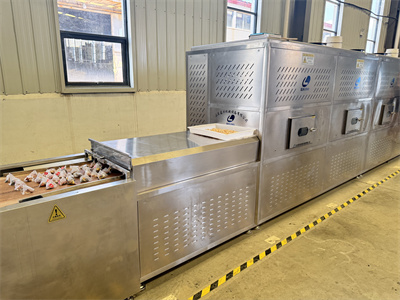
In the process of core sterilization and insecticidal processing, the free water inside the material will naturally evaporate with high-frequency molecular vibration, achieving uniform and mild drying, which belongs to the process incidental gain effect. Without the need to separately install drying equipment, it is possible to optimize the water content of tea, avoid secondary mold caused by humid environments, and further assist in extending the shelf life of products.




 QQ
QQ