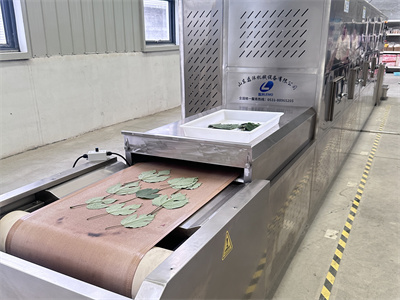
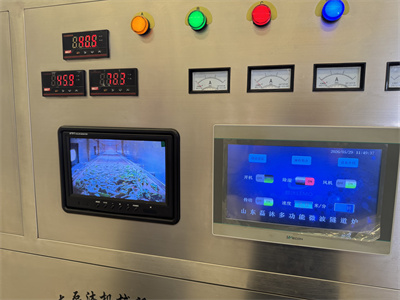
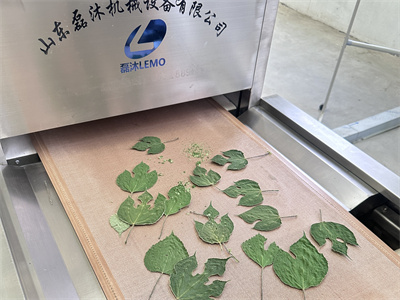
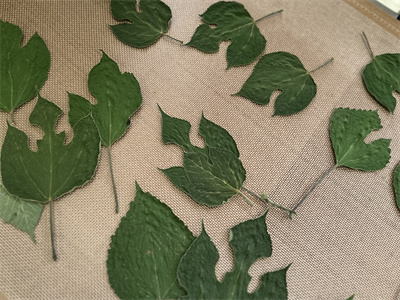
Using a microwave tunnel oven to process leaves can effectively lock in the original green color of the leaves, preserve their complete shape, and reduce breakage. Unlike conventional drying equipment, this set of equipment cannot directly set the drying temperature and duration. Many people may wonder, what does it rely on to flexibly adjust the drying degree of leaves?
The core lies in controlling the time that materials stay inside the equipment, that is, the running speed of the conveyor belt, while adjusting the microwave output power. Microwaves belong to penetrating endogenous heating, where water molecules inside the leaves absorb microwave energy and generate heat on their own, causing the entire leaf to dehydrate synchronously.
If you want a higher dryness, lower the speed of the conveyor belt so that the leaves can stay in the microwave area for a longer period of time and fully remove the internal moisture; Only mild dehydration is needed to maintain color, which accelerates the conveying speed, shortens the processing time, and avoids excessive heating of the leaves.
This adjustment method is suitable for the characteristics of different types of leaves. Some leaves are thin and tender, and can easily lose their green color due to prolonged high temperatures; Some leaves are thick and the moisture in the petiole is difficult to remove. By combining the speed and power of the conveyor belt, the total amount of dehydration can be flexibly controlled.
Compared to sun drying and oven drying, microwave treatment provides even heating and synchronized dehydration of both the inside and outside of the leaves, avoiding external dryness and internal moisture. As long as the parameters are properly matched, the original color of the leaves can be preserved to the greatest extent possible, reducing the probability of leaf curling and cracking. The finished product is suitable for plant specimens, dry leaf decoration, and other purposes.
Of course, when processing, attention should also be paid to the fact that stacking too thick leaves can cause uneven heating, and it is necessary to evenly spread the material in order to stably control the drying effect.




 QQ
QQ