Why do we need to use dry pork skin puffing raw materials?
Many people have tried crispy and delicious fried pork skin, and now there are also many processing factories tr...
About Production Shipment
For conventional customized equipment, we will complete the production in 7-15 days, the equipment could be shipped after your confirmation.
If available, it can be delivered directly.
Service commitment
After the arrival of the equipment, we will assign professional after-sales personnel to go to site for installation, guidance, commissioning, training, etc.
For those equipment cannot be installed on site, we will provide one-to-one video guidance for installation.
After sales service commitment
Within the agreed warranty period, all components of the equipment will be provided free of charge. Provide lifelong technical maintenance and repair services.
Tel:+86 53188965205
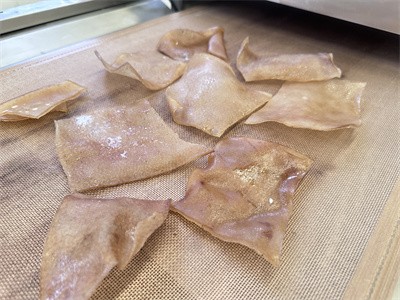
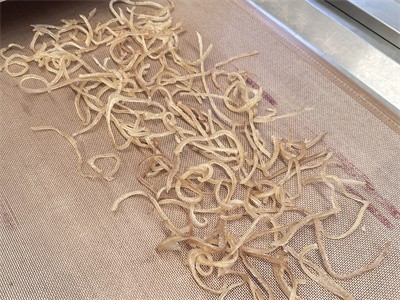
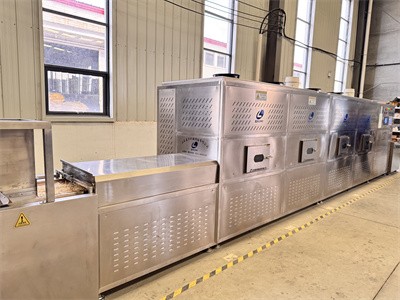
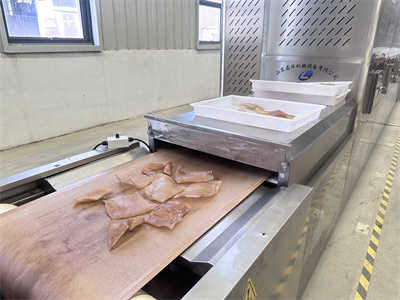
Many people have tried crispy and delicious fried pork skin, and now there are also many processing factories trying to use microwave technology to make non fried puffed pork skin. There is an interesting detail here: whether it is a small-scale trial or mass production, the pig skin raw materials used for microwave puffing almost always need to be fully dried first, and it is rare to directly microwave treat wet pig skin. Many people may wonder: Why can't we skip the step of drying when microwave itself can heat and dehydrate?
This is not a habit set arbitrarily, but determined by the working characteristics of microwaves and the structure of pigskin itself.
The main component of pigskin is collagen, which also contains fat and water. To achieve ideal puffing, in simple terms, it is to quickly vaporize the internal moisture, generate sufficient steam pressure, stretch and swell the collagen fibers, cool them, and shape them into a porous and crispy state. But this process is very particular about the "initial moisture content".
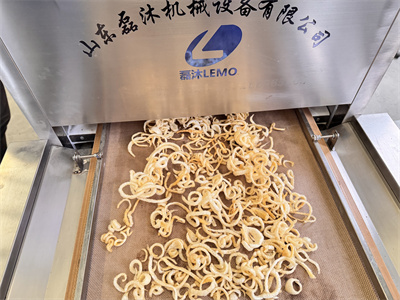
If wet pigskin with high moisture content is directly exposed to microwaves: initially, a large amount of free water will preferentially absorb microwave energy, and the heat is mainly used to evaporate surface and shallow water. The evaporation of water requires the absorption of a large amount of heat, making it difficult to quickly raise the temperature inside the billet to a sufficiently high level; The internal heating is slow, the vaporization is gentle, and the generated steam pressure is insufficient, making it difficult to fully support the structure. Often, in the end, it is only "cooked and dried" and cannot be puffed up, or only slightly bulged locally, failing to achieve a fluffy and crispy effect. Moreover, if a large amount of water is exposed to heat for a long time, collagen is prone to softening, becoming sticky, and even causing severe oiling and surface burning, resulting in unsatisfactory appearance and taste.
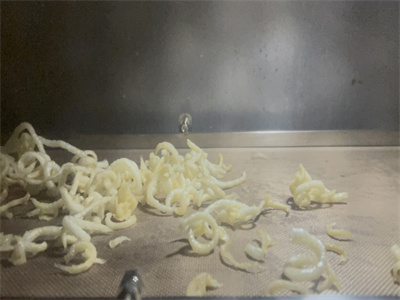
After pre drying, the situation is different. Drying is not about completely removing water, but about removing most of the free water and retaining a portion of the bound water. At this point, the texture of the billet is compact, which can better retain the heat generated by microwaves inside. After entering the microwave cavity, the remaining small amount of water quickly absorbs heat and vaporizes rapidly in a short period of time, instantly forming a large internal vapor pressure. Pressure pushes the collagen network outward, forming a fine and porous structure, achieving uniform expansion. After cooling, a crispy finished product is obtained.
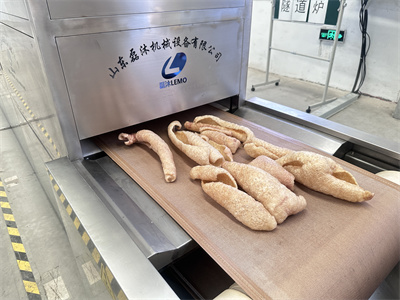
Of course, drying is not necessarily better. If it is dried too much, with too little water and insufficient vaporization medium, and also lacks sufficient steam pressure, the pigskin will be difficult to expand and easily become hard and burnt. In production, pig skin raw materials are usually dried to a suitable moisture range before being subjected to microwave puffing.


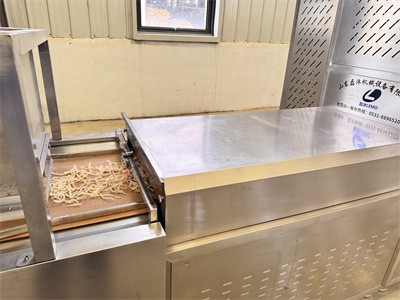


 QQ