In the wood processing industry, drying, softening, and shaping are key processes that affect the quality and production efficiency of finished products. Microwave heating equipment, with its unique working principle, exhibits characteristics such as fast heating speed, good shaping effect, and ease of subsequent processing in wood product processing, making it a highly practical processing equipment in the industry.
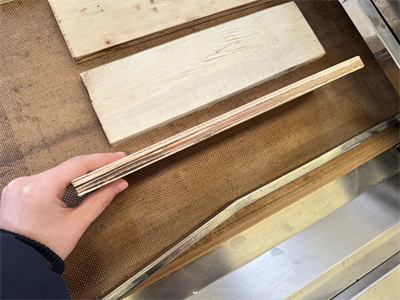
The reason why microwave heating equipment for wooden products has a fast heating speed lies in its working principle of penetrating heating. Unlike traditional heat conduction from the surface to the interior, microwaves can directly penetrate the surface of wood and act on water molecules inside. Wood itself contains a certain amount of moisture, and water molecules are polar molecules that undergo high-speed vibration and friction under the action of microwave electromagnetic fields, thereby rapidly generating heat. This kind of heat does not rely on external temperature to slowly penetrate, but is directly generated inside the wood, so the heating process is very rapid and can reach the required temperature and moisture content standards for processing in a short period of time, greatly reducing the heating treatment time.
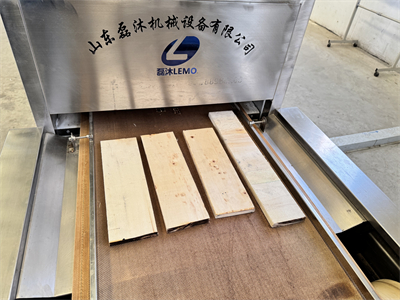
At the same time, microwave heating has the characteristic of uniform heating as a whole, and there will be no overheating of the wood surface or insufficient internal temperature. The uniform temperature distribution allows the moisture inside the wood to evaporate or migrate evenly, avoiding problems such as cracking, deformation, and excessive internal stress caused by uneven dryness and wetness, large differences in thermal expansion and contraction. This is also an important reason why microwave heating is suitable for fine processing of wood products.
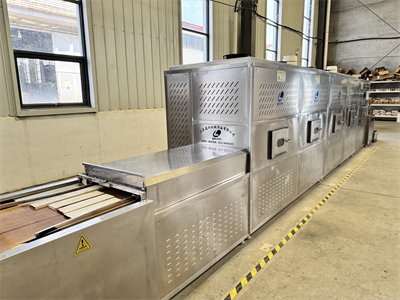
Fast and uniform heating provides a good foundation for the subsequent shaping and processing of wooden products. After microwave treatment, the internal moisture content of the wood is stable, the fiber structure is in a uniformly softened state, and the plasticity is significantly improved. In the shaping processes such as bending, pressing, and shaping, uniformly softened wood is easy to form according to the mold shape, with low rebound rate and good shape retention, which can effectively improve the forming qualification rate of wood products.




 QQ
QQ