Why are soaked beans more crispy after baking
I don't know if the miscellaneous grain processing manufacturers have noticed such a phenomenon: using microwav...
About Production Shipment
For conventional customized equipment, we will complete the production in 7-15 days, the equipment could be shipped after your confirmation.
If available, it can be delivered directly.
Service commitment
After the arrival of the equipment, we will assign professional after-sales personnel to go to site for installation, guidance, commissioning, training, etc.
For those equipment cannot be installed on site, we will provide one-to-one video guidance for installation.
After sales service commitment
Within the agreed warranty period, all components of the equipment will be provided free of charge. Provide lifelong technical maintenance and repair services.
Tel:+86 53188965205
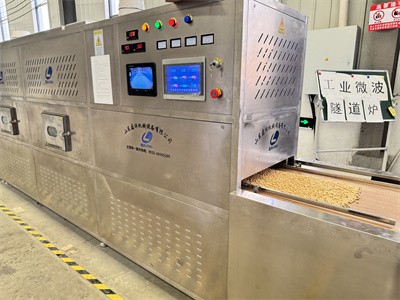
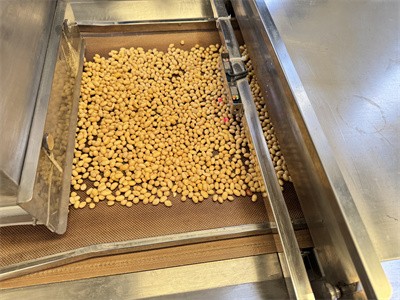
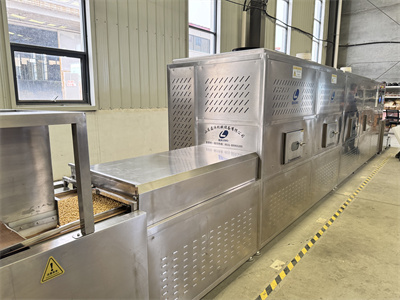
I don't know if the miscellaneous grain processing manufacturers have noticed such a phenomenon: using microwave equipment to bake soybeans, the untreated dried soybeans are harder, tighter, and have a tough bite, while the soybeans soaked in advance have fluffy particles, light texture, and crispy texture when baked. The difference in taste produced by the same equipment is mainly due to the synergistic puffing effect of pre treated moisture and microwave internal heating.
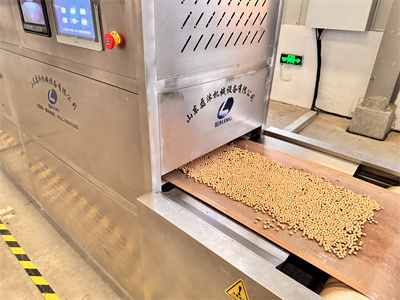
The internal structure of raw and dried soybeans is dense, with starch and protein in a compressed and solidified state. There are almost no pores inside, and the overall structure is hard and rigid. When microwave baking is directly performed, the moisture content inside the beans is low, and there are insufficient water molecules. During the heating process, sufficient steam expansion thrust cannot be generated, and only the moisture can be slowly dried. The structure of dehydrated soybeans continues to shrink and harden, with a dense interior, making the finished product hard, tough, and not brittle to eat.
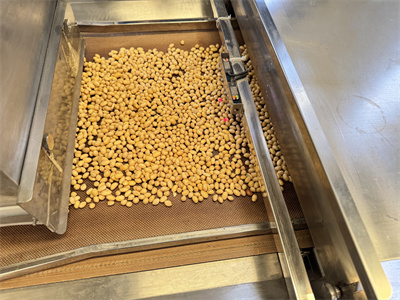
Pre soaking is a key pre-treatment step in creating a crispy texture. During the soaking process in clean water, water will fully penetrate into the interior of soybean seeds, allowing the compressed starch and protein tissues to absorb water, stretch, and expand. The originally compact internal structure is softened and reconstructed, forming a large number of fine natural pores, providing a basic space for subsequent microwave puffing.
After entering the microwave baking stage, the difference becomes apparent. Microwave is a penetrating integral heating method that can synchronize the temperature inside and outside of soybeans. Soaking soybeans with sufficient moisture inside will rapidly heat and vaporize, forming a uniform and stable vapor pressure inside the beans, evenly spreading the softened tissue structure inside, and forming a uniform honeycomb porous structure.
As the microwave continues to dehydrate, the internal water vapor is quickly expelled, and the loose pore structure is shaped and will not retract. After baking, the soybeans have rich internal cavities, light structure, and are easily broken under stress, ultimately forming a unique crispy taste.




 QQ