In daily life, many people have the experience of heating boxed meals in a regular microwave at home: some parts of the food are scalded, some parts are still slightly cold, the middle is hot and the edges are slightly cold, and even the meat pieces are scalded and the rice is not yet hot, so it needs to be taken out and mixed once in the middle. But in the microwave tunnel ovens used in central kitchens and catering factories for large-scale reheating of boxed meals, this phenomenon of uneven heating and cooling rarely occurs. Many people are curious about the difference between microwave heating and microwave heating?
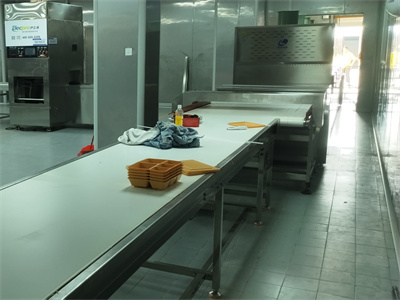
The uneven heating of household microwave ovens mainly comes from the characteristics of standing waves in the cavity. Microwaves form standing waves in a narrow cavity, producing peaks and valleys of energy. The energy at the peak position rises rapidly, while the energy at the valley position rises weakly and rises slowly. Even with a turntable, it can only improve to a certain extent, and it is difficult to completely eliminate hot and cold areas. In addition, the moisture content of rice, meat, and vegetables in boxed meals varies greatly, and the ability of different ingredients to absorb microwaves varies greatly, further exacerbating uneven heating.
The design and operation of microwave tunnel ovens have addressed this pain point in a targeted manner. Firstly, the boxed meals are placed on a continuous conveyor belt and slowly and uniformly pass through the tunnel cavity. The materials constantly change positions during their movement, continuously passing through areas with different levels of microwave energy to avoid staying at low energy points for a long time. At the same time, the tunnel cavity is longer, and multiple sets of microwave sources are arranged in a staggered manner inside. Microwaves are fed into the cavity from multiple directions, and the energy distribution is more uniform compared to household small cavities, greatly reducing the local temperature difference caused by standing waves.
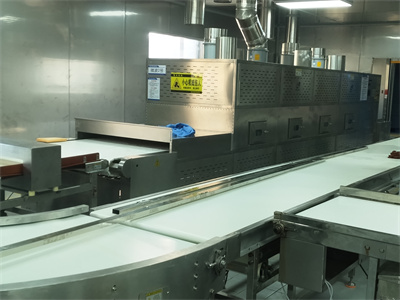
Secondly, the production line can adjust the conveyor belt speed and power according to the type of boxed meal. The differences in dielectric properties of rice, meat dishes and vegetables in the boxed lunch are objective. The factory can debug the parameters in advance, match the overall temperature rise rate of the boxed lunch, and with the help of hot air inside the cavity, the surface heat can be further conducted to reduce the temperature difference between different food materials. The continuous processing mode also ensures stable heating time for boxed meals inside the chamber.
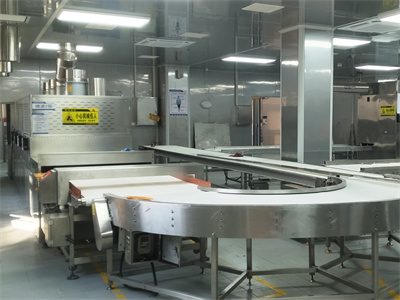
Of course, it is not absolutely without temperature differences, and for boxed meals with particularly large thickness and complex ingredients, process debugging and optimization are still needed. Compared to household microwave ovens, microwave tunnel ovens rely on a multi feed layout and continuous conveying to achieve stable and uniform reheating of large quantities of boxed meals. This is also an important reason why group meals and pre packaged meal preparation companies choose them for boxed meal reheating.




 QQ