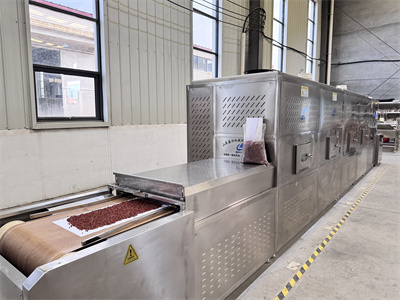
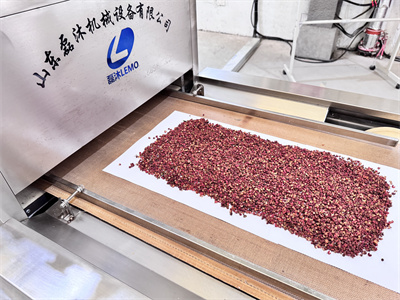
Chili noodles, Sichuan pepper powder, cumin powder and other spices are the core flavors of many dishes and snacks. In spice processing, microwave equipment often completes drying and sterilization at the same time. I wonder if you have found that the spice after microwave treatment has a stronger aroma than the raw material, which is not the addition of essence, but the physical and chemical changes under the action of microwave.
The flavor compounds of spices are mostly stored in the essential oil glands and cells of the raw materials. Untreated raw materials have intact cell structures, and a large amount of aroma components are locked inside the cells, making it difficult to fully release them.
Microwaves belong to penetrating heating, and energy can be directly applied to the interior of spice powder. The moisture in the material rapidly heats up and vaporizes under the action of microwave, and the pressure generated inside the cell will break through the originally tight cell wall. The aromatic essential oil and flavor substances originally trapped in the cell will be released, and the fragrance we smell will become prominent.
At moderate temperature conditions, mild Maillard reactions and flavor precursor transformations occur inside the spices. Unlike long-term high-temperature baking, microwave heating is fast and the processing time is short. It can awaken various aromatic substances and enrich the aroma layers without excessively roasting the raw materials. It not only retains its unique pungent aroma, but also makes the aroma mellow.
During this process, drying and sterilization are also completed simultaneously. Spice raw materials are prone to carrying microorganisms and insect eggs. Microwaves use thermal effects to destroy microbial cells, achieve sterilization, reduce moisture, and extend product shelf life, achieving multiple effects in one process.
Attention should be paid to the control of process parameters here. If the power is too high and the heating time is too long, it will cause the essential oil to evaporate excessively, resulting in a weakened fragrance and burnt appearance. Only by controlling the microwave power and processing time can the natural aroma of the spice be moderately stimulated while drying and sterilizing.





 QQ